Key Specifications
| Product Type | Stud Bolt |
|---|---|
| Material / Grade | ASTM A193 Grade B7, B7M, B16, B8 and B8M, ASTM A320 Grade L7, L7M, B8 and B8M |
| Standard | ASTM, ASME, API, DIN, ISO |
| Size Range | 1/2 to inch |
| Certification | MTC 3.1 /3.2 EN 10204 certificate and inspection requirements |
| Thread Series | Add verified thread series and class |
We are a professional stud bolt manufacturer and supplier in China, providing high-strength bolting assemblies for flanges, valves, pressure vessels, pipelines, heat exchangers and industrial pressure equipment.
Our product range includes fully threaded stud bolts, double-end studs, tap-end studs and stud bolts supplied with two heavy hex nuts. Available materials include ASTM A193 Grade B7, B7M, B16, B8 and B8M, as well as ASTM A320 Grade L7, L7M, B8 and B8M for low-temperature service.
Stud bolts can be supplied with plain, black oxide, phosphate, zinc-plated, hot-dip galvanized, PTFE-coated or Xylan-coated finishes. Each order can be manufactured according to the required material grade, thread series, length, coating system, flange standard and project specification.
Stud Bolt Supply Capabilities
| Item | Available Options |
|---|---|
| Product types | Fully threaded stud bolts, double-end studs, tap-end studs and custom studs |
| Bolting materials | ASTM A193 B7, B7M, B16, B8, B8M and other specified grades |
| Low-temperature materials | ASTM A320 L7, L7M, B8, B8M and other specified grades |
| Matching nuts | ASTM A194 2H, 2HM, 4, 7, 7M, 8 and 8M |
| Thread systems | UNC, UNF, 8UN, metric coarse and metric fine |
| Thread classes | ASME B1.1 Class 2A and 2B, or as specified |
| Surface finishes | Plain, black oxide, phosphate, zinc plated, HDG, PTFE and Xylan |
| Dimensional standards | ASME, ASTM, API, BS, DIN, ISO and customer drawings |
| Documentation | EN 10204 3.1 /3.2 MTC, inspection report, coating report and test certificates |
| Inspection options | Visual, dimensional, hardness, mechanical, PMI, coating and third-party inspection |
What Is a Stud Bolt?
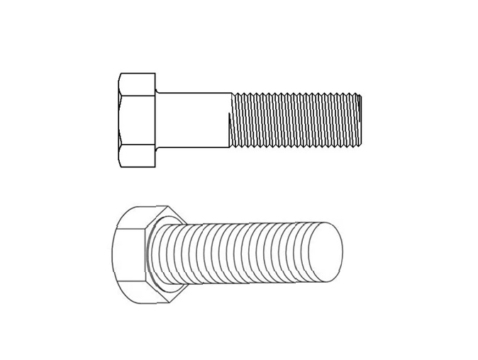
A stud bolt is a threaded fastener normally used with two nuts to connect flanges or other pressure-retaining components. Unlike a conventional hex bolt, a flange stud bolt usually has no bolt head and may be threaded over its full length.
Stud bolts are widely used because they allow controlled tightening from both sides of a flanged connection. Correctly selected and installed stud bolts help generate the clamping force required to compress the gasket and maintain the integrity of the joint.
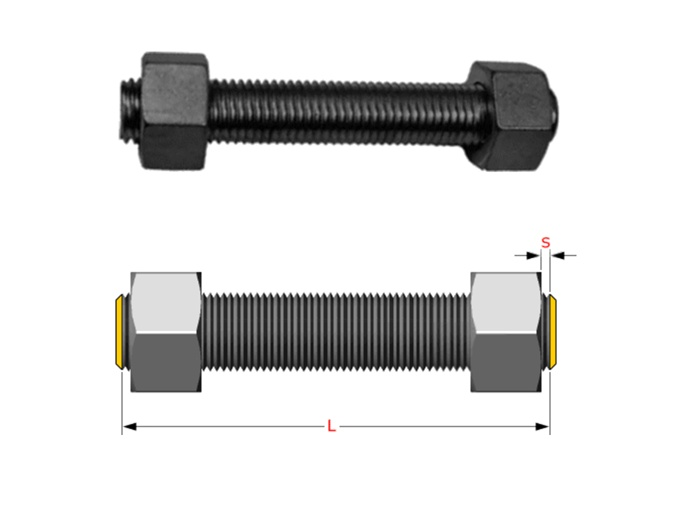
A complete flange bolting assembly normally includes:
- One fully threaded stud bolt.
- Two heavy hex nuts.
- Washers when required by the project specification.
- A specified coating or surface treatment.
- Material and inspection certificates.
The stud bolt grade, nut grade, diameter, thread pitch, length and coating must be selected according to the flange design, operating temperature, pressure, process medium and project requirements.
Stud Bolt Product Range
Fully Threaded Stud Bolts
Fully threaded stud bolts have continuous external threads along the usable length of the fastener. They are the most common type used for ASME pipeline flanges, pressure vessels, valves, pumps and industrial piping systems.
They are generally supplied as a set with two ASTM A194 heavy hex nuts. Custom lengths, thread pitches, material grades and coating systems are available.
Stud Bolts with Two Heavy Hex Nuts
We supply complete stud bolt assemblies with two heavy hex nuts, allowing the material and thread compatibility of the complete assembly to be controlled before shipment.
Common combinations include:
- ASTM A193 B7 stud bolt with ASTM A194 2H nuts.
- ASTM A193 B7M stud bolt with ASTM A194 2HM nuts.
- ASTM A320 L7 stud bolt with ASTM A194 7 nuts.
- ASTM A320 L7M stud bolt with ASTM A194 7M nuts.
- ASTM A193 B8 stud bolt with ASTM A194 8 nuts.
- ASTM A193 B8M stud bolt with ASTM A194 8M nuts.
Final material pairing must follow the applicable design code, project specification and purchase order.
Double-End Studs
A double-end stud has threaded sections on both ends with an unthreaded shank in the middle. This type is commonly used for equipment, machinery, valves, pumps, pressure vessels and applications where one end is installed into a tapped component.
The thread length, unthreaded shank length and overall length can be manufactured according to the customer’s drawing.
Tap-End Studs
A tap-end stud is designed with one end screwed into a tapped hole and the other end secured with a nut. The tap end and nut end may have different thread lengths or thread classes.
Tap-end studs are commonly used in valves, pumps, turbine housings, pressure equipment and machinery assemblies.
API 20E Stud Bolts
Stud bolts for oil and gas equipment can be supplied according to API Specification 20E when required by the purchase order.
API 20E bolting requires additional control over raw materials, manufacturing procedures, heat treatment, testing, traceability, inspection and documentation. The applicable bolting specification level and supplementary requirements must be clearly stated at the quotation and ordering stage.
Custom Stud Bolts
Custom stud bolts can be manufactured according to:
- Customer drawings.
- Equipment specifications.
- Non-standard lengths.
- Special thread configurations.
- Project-specific hardness requirements.
- Controlled coating thickness.
- Color-coded coating systems.
- Special marking and traceability requirements.
Stud Bolt Materials and Grades
ASTM A193 Stud Bolts
ASTM A193 covers alloy-steel and stainless-steel bolting used for high-temperature, high-pressure and other special-purpose applications. Typical components include pressure vessels, valves, flanges and fittings.
| Stud Bolt Grade | Material Type | Typical Application | Common Nut Grade |
|---|---|---|---|
| ASTM A193 B7 | Chromium-molybdenum alloy steel | High-pressure and elevated-temperature flange connections | ASTM A194 2H |
| ASTM A193 B7M | Controlled-hardness alloy steel | Applications requiring restricted hardness, including certain sour-service projects | ASTM A194 2HM |
| ASTM A193 B16 | Chromium-molybdenum-vanadium alloy steel | High-strength elevated-temperature applications | As specified by the design code |
| ASTM A193 B8 Class 1 | 304 stainless steel | General corrosion-resistant bolting | ASTM A194 8 |
| ASTM A193 B8 Class 2 | Strain-hardened 304 stainless steel | Higher-strength stainless-steel bolting | ASTM A194 8 |
| ASTM A193 B8M Class 1 | 316 stainless steel | Corrosive industrial environments | ASTM A194 8M |
| ASTM A193 B8M Class 2 | Strain-hardened 316 stainless steel | Higher-strength and corrosion-resistant bolting | ASTM A194 8M |
ASTM A193 B7 Stud Bolts
ASTM A193 Grade B7 stud bolts are among the most commonly used flange fasteners in oil and gas, petrochemical, refinery, power-generation and industrial piping systems.
B7 is a heat-treated chromium-molybdenum alloy-steel grade offering high tensile strength and reliable performance in high-pressure and elevated-temperature service.
B7 stud bolts are commonly supplied with:
- ASTM A194 Grade 2H heavy hex nuts.
- UNC or 8UN threads.
- Plain or black finish.
- PTFE or Xylan coating.
- Hot-dip galvanized finish.
- EN 10204 3.1 material certification.
ASTM A193 B7M Stud Bolts
ASTM A193 Grade B7M stud bolts are manufactured with controlled mechanical properties and restricted hardness. They are frequently specified for projects where hardness control is important.
B7M stud bolts are commonly paired with ASTM A194 Grade 2HM nuts.
The grade designation alone does not automatically establish compliance with every sour-service requirement. Material chemistry, heat treatment, hardness, manufacturing method, coating, testing and documentation must be evaluated against the applicable project specification and NACE MR0175/ISO 15156 requirements.
ASTM A320 Low-Temperature Stud Bolts
ASTM A320 covers alloy-steel and stainless-steel bolting materials intended for low-temperature service, including bolting for pressure vessels, valves, flanges and fittings.
| Stud Bolt Grade | Material Type | Typical Application | Common Nut Grade |
|---|---|---|---|
| ASTM A320 L7 | Heat-treated alloy steel | Low-temperature pressure piping and equipment | ASTM A194 7 |
| ASTM A320 L7M | Controlled-hardness alloy steel | Low-temperature service requiring restricted hardness | ASTM A194 7M |
| ASTM A320 B8 Class 1 | 304 stainless steel | Low-temperature corrosion-resistant service | ASTM A194 8 |
| ASTM A320 B8M Class 1 | 316 stainless steel | Low-temperature and corrosive environments | ASTM A194 8M |
ASTM A320 L7 Stud Bolts
ASTM A320 Grade L7 stud bolts are commonly used for low-temperature flange connections and pressure-retaining equipment.
L7 stud bolts are usually impact tested according to the applicable material specification and purchase requirements. They are commonly supplied with ASTM A194 Grade 7 heavy hex nuts.
ASTM A320 L7M Stud Bolts
ASTM A320 Grade L7M stud bolts are a controlled-hardness version of L7 bolting. They are commonly paired with ASTM A194 Grade 7M heavy hex nuts.
Where sour-service compliance is required, the purchase order should clearly specify the applicable NACE standard, maximum hardness, testing requirements, certification and any supplementary manufacturing controls.
Stud Bolt Standards
Our stud bolts can be supplied according to the following standards and specifications:
| Standard | Scope |
|---|---|
| ASTM A193/A193M | Alloy-steel and stainless-steel bolting for high-temperature, high-pressure and special-purpose service |
| ASTM A320/A320M | Alloy-steel and stainless-steel bolting for low-temperature service |
| ASTM A194/A194M | Carbon-steel, alloy-steel and stainless-steel nuts for pressure and temperature service |
| ASME B1.1 | Unified inch screw threads, including UNC, UNF and 8UN |
| ASME B18.2.2 | Dimensional requirements for nuts, including heavy hex nuts |
| ASME B16.5 | Pipe flanges and flanged fittings within the applicable size and pressure-class range |
| ASME B16.47 | Large-diameter steel flanges |
| API Specification 20E | Alloy-steel and carbon-steel bolting for petroleum and natural-gas industries |
| API Specification 6A | Wellhead and tree equipment requirements |
| BS 4882 | Bolting for flanges and pressure-containing applications |
| NACE MR0175/ISO 15156 | Material requirements for equipment used in H₂S-containing oil and gas environments |
| MESC SPE 81/001 and 81/002 | Project-specific requirements for stud bolts and nuts when specified |
The required edition, supplementary requirements and project specifications should be stated in the purchase order.
Stud Bolt Threads
UNC Threads
UNC threads are commonly used for smaller-diameter flange stud bolts. They have a coarser pitch, making them practical for general industrial assembly and maintenance.
8UN Threads
8UN threads have eight threads per inch regardless of the nominal bolt diameter. They are commonly used for larger flange stud bolts in ASME piping systems.
For many ASME flange applications:
- Stud bolts up to and including 1 inch commonly use UNC threads.
- Stud bolts 1-1/8 inches and larger commonly use 8UN threads.
The required thread series must always be confirmed against the flange standard, equipment drawing and purchase order.
Metric Threads
Metric stud bolts are available with:
- Metric coarse threads.
- Metric fine threads.
- Standard metric tolerances.
- Custom thread pitches according to drawings.
Typical designations include M16, M20, M24, M27, M30, M33, M36, M39, M42, M45, M48 and larger sizes.
Thread Class
Unless otherwise specified, unified external threads may be manufactured to Class 2A, while matching internal nut threads may be manufactured to Class 2B.
For coated stud bolts, the required coating thickness and thread allowance must be controlled to prevent thread interference after coating.
Stud Bolt Length
Stud bolt length must be selected according to:
- Flange standard and pressure class.
- Flange thickness.
- Gasket thickness.
- Number and thickness of washers.
- Nut height.
- Required thread projection beyond each nut.
- Any insulation kit or special flange accessory.
The purchase order should clearly state how the nominal length is measured, particularly whether chamfered or pointed ends are included or excluded.
For standard flange connections, bolting dimensions may be selected from the applicable flange standard. For non-standard equipment, the required stud length should be calculated from the actual joint assembly.
Stud Bolt Coatings and Surface Treatments
The coating system should be selected according to the installation environment, operating temperature, corrosion exposure, assembly method and required coefficient of friction.
| Coating or Finish | Main Characteristics | Typical Applications |
|---|---|---|
| Plain finish | No additional metallic or polymer coating | Controlled indoor or protected environments |
| Black oxide | Dark appearance with limited corrosion protection | General industrial use with suitable preservation |
| Phosphate coating | Improves oil retention and provides a base for additional protection | Industrial bolting and controlled assembly |
| Zinc plating | Sacrificial metallic protection | General atmospheric environments |
| Hot-dip galvanizing | Relatively thick zinc protection | Outdoor structures and industrial installations |
| PTFE coating | Low-friction polymer coating with corrosion resistance | Flanges, petrochemical plants and offshore projects |
| Xylan coating | Fluoropolymer coating with controlled friction and color options | Oil and gas, offshore, marine and industrial piping |
| Zinc-nickel coating | Enhanced corrosion protection compared with conventional zinc systems | Demanding industrial and marine environments |
PTFE-Coated Stud Bolts
PTFE-coated stud bolts are widely used where corrosion protection and controlled friction are required. The coating can reduce thread friction and support more consistent tightening when the correct torque procedure is applied.
Available PTFE coating colors may include:
- Blue.
- Green.
- Red.
- Yellow.
- Black.
- Grey.
- Customer-specified color coding.
The coating manufacturer, coating system, dry-film thickness, curing process and friction requirements should be specified for critical applications.
Xylan-Coated Stud Bolts
We supply stud bolts with coating systems such as:
- Xylan 1014.
- Xylan 1070.
- Xylan 1424.
- Other specified fluoropolymer systems.
Xylan-coated stud bolts are commonly used in oil and gas, offshore, petrochemical, marine and industrial flange connections.
Because coating affects friction, torque and thread fit, coated bolting should be tightened using a procedure based on the approved lubricant or coating coefficient rather than an unverified torque value.
Manufacturing Process
Stud bolt production can include the following stages:
- Raw-material inspection and verification.
- Material identification and heat-number traceability.
- Cutting to the required blank length.
- Heat treatment when required by the material specification.
- Thread rolling or thread cutting.
- End chamfering and dimensional finishing.
- Hardness and mechanical-property testing.
- Surface preparation.
- Coating or plating.
- Final dimensional and visual inspection.
- Marking and traceability verification.
- Packing and documentation review.
The manufacturing route is selected according to the stud diameter, material grade, required thread, quantity, applicable standard and project specification.
Quality Inspection and Testing
Stud bolts can be inspected and tested according to the material standard, project specification and inspection and test plan.
Available Inspection Items
- Raw-material certificate review.
- Chemical composition verification.
- Tensile testing.
- Yield-strength testing.
- Elongation and reduction-of-area testing.
- Hardness testing.
- Charpy impact testing when required.
- Positive material identification.
- Dimensional inspection.
- Thread gauge inspection.
- Coating-thickness measurement.
- Visual coating inspection.
- Marking and traceability inspection.
Certification and Documentation
Available documentation may include:
- EN 10204 3.1 material certificate.
- Chemical and mechanical test reports.
- Heat-treatment records.
- Hardness test report.
- Impact test report.
- Dimensional inspection report.
- Thread inspection report.
- Coating certificate.
- Coating-thickness report.
- PMI report.
- Certificate of conformity.
- Inspection and test plan.
- Third-party inspection release note.
Third-party inspection by SGS, Bureau Veritas, TÜV, DNV, ABS or Lloyd’s Register can be arranged when required by the purchase order.
Stud Bolt Marking and Traceability
Stud bolts can be marked according to the applicable material standard and project requirements.
Marking information may include:
- Manufacturer identification.
- Material grade.
For small diameters or products where full marking is impractical, traceability can be maintained through tagged bundles, sealed packaging and batch documentation.
Stud Bolt Applications
Our stud bolts are supplied for:
- Oil and gas pipelines.
- Refineries.
- Petrochemical plants.
- Chemical-processing equipment.
- LNG facilities.
- Offshore platforms.
- Marine piping systems.
- Power plants.
- Pressure vessels.
- Heat exchangers.
- Industrial valves.
- Pumps and compressors.
- Wellhead and tree equipment.
- Water-treatment plants.
- Mining and heavy industrial equipment.
Stud Bolts for Pipeline Flanges
Flange stud bolts are used to connect:
- Weld-neck flanges.
- Slip-on flanges.
- Blind flanges.
- Socket-weld flanges.
- Threaded flanges.
- Lap-joint flanges.
- Long weld-neck flanges.
- Orifice flanges.
- API 6A flanges.
- Compact and custom flanges.
Bolting selection must be compatible with the flange material, pressure class, gasket type, operating temperature and design code.
How to Order Stud Bolts
For an accurate quotation, provide the following information:
| Required Information | Example |
|---|---|
| Product | Fully threaded stud bolt with two heavy hex nuts |
| Diameter | 1-1/8 inch |
| Thread | 8UN |
| Length | 145 mm |
| Stud material | ASTM A193 Grade B7 |
| Nut material | ASTM A194 Grade 2H |
| Nut quantity | Two nuts per stud |
| Coating | Xylan 1424 |
| Thread class | 2A stud and 2B nut |
| Quantity | 500 sets |
| Certification | EN 10204 3.1 |
| Additional standard | ASME B1.1, ASME B18.2.2 or project specification |
| Inspection | Manufacturer inspection or third-party inspection |
A recommended purchase description is:
STUD BOLT COMPLETE WITH TWO HEAVY HEX NUTS, SIZE 1-1/8 INCH 8UN × 145 MM LONG, STUD MATERIAL ASTM A193 GRADE B7, NUT MATERIAL ASTM A194 GRADE 2H, XYLAN 1424 COATED, THREAD CLASS 2A/2B, COMPLETE WITH EN 10204 3.1 CERTIFICATION.
Why Choose Our Stud Bolts?
Complete Bolting Assemblies
Stud bolts can be supplied together with compatible heavy hex nuts and washers, reducing the risk of receiving mismatched material grades or thread dimensions.
Custom Manufacturing
We support non-standard diameters, lengths, thread pitches, material combinations, coatings, marking and packing requirements.
Material Traceability
Material heat numbers and production batches can be maintained throughout manufacturing, inspection, coating and final packing.
Coating Options
Multiple coating systems are available for general industrial, marine, offshore, petrochemical and corrosive environments.
Project Documentation
Material certificates, mechanical test reports, hardness reports, coating reports and third-party inspection documents can be supplied according to the purchase order.
Export Packing
Stud bolts can be packed in cartons, plywood cases, steel drums or project-specific export packaging. Each package can be labeled with the purchase-order number, item number, material grade, size, quantity and heat number.
Frequently Asked Questions
What is the difference between a stud bolt and a regular bolt?
A stud bolt normally has no bolt head and is secured with nuts on both ends. A regular bolt has an integral head and normally uses one nut. Stud bolts are widely used for flange connections because tightening can be controlled from either side of the joint.
Which stud bolt grade is commonly used for pipeline flanges?
ASTM A193 Grade B7 is one of the most common alloy-steel stud bolt grades used for high-pressure and elevated-temperature pipeline flanges. It is commonly paired with ASTM A194 Grade 2H heavy hex nuts.
The final grade must be selected according to the design temperature, pressure, flange material, process medium and project specification.
What is the difference between ASTM A193 B7 and B7M?
Both B7 and B7M are alloy-steel bolting grades. B7 is widely used for high-pressure and elevated-temperature service. B7M is produced with controlled mechanical properties and restricted hardness.
B7M is frequently specified where hardness control is required, but compliance with a sour-service specification depends on more than the material designation alone.
What is the difference between ASTM A320 L7 and L7M?
ASTM A320 L7 is an alloy-steel bolting grade intended for low-temperature service. L7M is a controlled-hardness variation commonly selected for projects that impose additional hardness restrictions.
L7 is commonly paired with ASTM A194 Grade 7 nuts, while L7M is commonly paired with ASTM A194 Grade 7M nuts.
Which nuts are used with ASTM A193 B7 stud bolts?
ASTM A193 B7 stud bolts are commonly supplied with ASTM A194 Grade 2H heavy hex nuts. Nut selection must still be verified against the applicable code and purchase specification.
Can B7 stud bolts be supplied with PTFE or Xylan coating?
Yes. ASTM A193 B7 stud bolts can be supplied with PTFE, Xylan and other specified coating systems.
The coating specification should identify the coating type, color, thickness, curing requirements and any required coefficient-of-friction range.
Are B7M and L7M automatically NACE compliant?
No. A material grade alone does not automatically establish compliance with every NACE or sour-service requirement.
Compliance may depend on chemical composition, heat treatment, hardness, manufacturing method, cold work, testing, coating and documentation. The applicable edition and project-specific requirements must be reviewed before production.
What thread is used for flange stud bolts?
UNC threads are commonly used for smaller stud diameters, while 8UN threads are commonly used for larger ASME flange stud bolts. Metric threads are used for EN, DIN, ISO and customer-specific applications.
The exact thread series and pitch must be stated in the purchase order.
What does 8UN mean?
8UN is a unified thread series with eight threads per inch. It is commonly specified for large-diameter flange bolting because it provides a consistent thread pitch across multiple bolt diameters.
How is stud bolt length measured?
The length must be measured according to the applicable standard or drawing. Because different specifications may treat chamfered or pointed ends differently, the purchase order should define whether the stated nominal length is the overall physical length or the effective threaded length between the end points.
Are washers required with flange stud bolts?
Washers are not automatically required for every flange connection. They may be specified to protect coated surfaces, improve bearing conditions, accommodate insulation kits or satisfy a project installation procedure.
The use of washers should follow the flange design and approved bolting procedure.
Can stud bolts be supplied with EN 10204 3.1 certificates?
Yes. Stud bolts and matching nuts can be supplied with EN 10204 3.1 material certificates, provided the certification requirement is confirmed when the order is placed.
Additional reports such as hardness, impact testing, PMI, dimensional inspection and coating inspection can also be supplied when specified.
Can you manufacture non-standard stud bolts?
Yes. Non-standard stud bolts can be produced according to customer drawings, including special diameters, overall lengths, thread lengths, thread pitches, material grades, coatings, markings and inspection requirements.
What information is required for a stud bolt quotation?
The required information normally includes diameter, thread pitch, length, stud material, nut material, number of nuts, coating, quantity, certification and applicable standard.
For project orders, the design code, NACE requirements, inspection level and third-party inspection requirements should also be provided.
Request a Stud Bolt Quotation
Send us your stud bolt specification, bill of materials or project datasheet for quotation.
Please include:
- Stud bolt diameter and length.
- Thread series and pitch.
- Stud material grade.
- Nut material grade.
- Number of nuts per stud.
- Required coating.
- Quantity.
- Certification requirements.
- Applicable flange or project standard.
- Required delivery schedule.
- Third-party inspection requirements.
We supply ASTM A193 B7, B7M, B8, B8M and B16 stud bolts, ASTM A320 L7 and L7M low-temperature stud bolts, matching ASTM A194 heavy hex nuts, and custom-coated bolting assemblies for international industrial projects.