Equivalent and Comparable Grades
- ASTM A193 Grade B7
ASTM A193 Grade B7 Material Specification
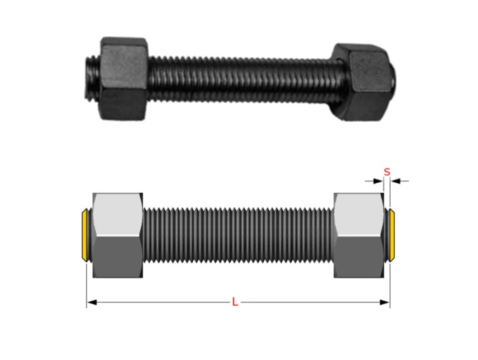
ASTM A193 Grade B7 is a chromium-molybdenum alloy steel bolting material designed for high-temperature, high-pressure and other special-purpose applications. It is commonly supplied as stud bolts, threaded rods and headed bolts for pressure vessels, valves, flanges, fittings and industrial piping systems.
The current active standard is ASTM A193/A193M-26, published in March 2026. Material selection should always be based on the specified standard edition, service conditions and project requirements. (ASTM Store)
What Is ASTM A193 Grade B7?
Grade B7 is produced from medium-carbon chromium-molybdenum alloy steel, commonly associated with AISI 4140 or 4142 steel. The material is quenched and tempered to achieve its required tensile strength, yield strength and hardness.
Typical product forms include:
- Stud bolts
- Fully threaded rods
- Double-end studs
- Hex bolts
- Custom-machined bolting components
ASTM A193 B7 is widely used for bolted flange joints in the oil and gas, petrochemical, power-generation and pressure-equipment industries.
ASTM A193 B7 Chemical Composition
| Element | Requirement |
|---|---|
| Carbon | 0.38–0.48% |
| Manganese | 0.75–1.00% |
| Phosphorus | 0.035% max. |
| Sulfur | 0.040% max. |
| Silicon | 0.15–0.35% |
| Chromium | 0.80–1.10% |
| Molybdenum | 0.15–0.25% |
The combination of chromium and molybdenum improves hardenability, strength and elevated-temperature performance compared with ordinary carbon-steel bolting.
ASTM A193 B7 Mechanical Properties
Mechanical requirements vary according to the nominal diameter of the bolting material.
| Nominal Diameter | Tensile Strength, Min. | Yield Strength, Min. | Elongation, Min. | Reduction of Area, Min. |
|---|---|---|---|---|
| Up to 2-1/2 in. | 125 ksi / 860 MPa | 105 ksi / 720 MPa | 16% | 50% |
| Over 2-1/2 to 4 in. | 115 ksi / 795 MPa | 95 ksi / 655 MPa | 16% | 50% |
| Over 4 to 7 in. | 100 ksi / 690 MPa | 75 ksi / 515 MPa | 18% | 50% |
The maximum hardness is normally 321 HBW or 35 HRC. Actual acceptance values must be verified against the applicable edition of ASTM A193/A193M and the ordered diameter.
Heat Treatment
ASTM A193 Grade B7 material is supplied in a quenched-and-tempered condition. After rolling or forging, the ferritic steel is cooled below its transformation range before the specified heat-treatment process is completed.
Heat treatment is essential because chemical composition alone does not establish compliance. The finished bolting must also satisfy the required mechanical properties, hardness, testing and marking requirements. (
Compatible Nuts and Washers
ASTM A193 B7 stud bolts are commonly assembled with:
- ASTM A194 Grade 2H heavy hex nuts
- ASTM F436 hardened steel washers, when washers are required
- Grade 2H nuts with oversize tapping for certain coated or hot-dip-galvanized assemblies
The nut grade, thread allowance and coating system should be stated clearly in the purchase order.
Surface Coating Options
ASTM A193 B7 fasteners can be supplied with different surface finishes:
- Plain or black finish
- Zinc plating
- Hot-dip galvanizing
- Phosphate coating
- PTFE coating
- Xylan fluoropolymer coating
PTFE and Xylan coatings can provide improved corrosion protection, lower friction and more consistent assembly characteristics. However, the maximum service temperature of the complete fastener assembly may be limited by the selected coating, even when the base B7 material is suitable for a higher temperature.
ASTM A193 B7 vs B7M
| Property | ASTM A193 B7 | ASTM A193 B7M |
|---|---|---|
| Basic alloy chemistry | Chromium-molybdenum steel | Similar chromium-molybdenum steel |
| Strength | Higher | Lower |
| Maximum hardness | 321 HBW / 35 HRC | 235 HBW |
| Typical application | General high-pressure and high-temperature bolting | Applications requiring stricter hardness control |
| Hardness testing | According to standard requirements | More stringent lot testing requirements |
B7M should not automatically be described as NACE compliant. Suitability for sour service depends on hardness, manufacturing condition, environmental limits and the applicable NACE MR0175/ISO 15156 or project specification.
ASTM A193 Grade B7 Inspection Requirements
ASTM A193 Grade B7 bolting must be inspected and tested to verify its chemical composition, heat-treatment condition, mechanical properties, hardness, dimensions, surface quality and traceability.
The inspection requirements of ASTM A193/A193M are applied together with ASTM A962/A962M, which covers the common manufacturing, testing, dimensional, marking and certification requirements for high-temperature and high-pressure bolting. Where the two standards differ, the specific requirements of ASTM A193/A193M take precedence.
Required Inspection and Testing
| Inspection Item | Main Requirement |
|---|---|
| Chemical analysis | Verify that the heat composition complies with ASTM A193 Grade B7 |
| Tensile testing | Determine tensile strength, yield strength, elongation and reduction of area |
| Hardness testing | Confirm that hardness does not exceed the Grade B7 limit |
| Heat-treatment verification | Confirm that the material has been quenched and tempered |
| Dimensional inspection | Check diameter, length, thread dimensions and tolerances |
| Visual inspection | Check for cracks, laps, seams and other injurious defects |
| Wedge tensile testing | Required for applicable headed fasteners |
| Marking and traceability | Verify the B7 grade marking, manufacturer identification and heat traceability |
| Certification review | Confirm chemical, mechanical and heat-treatment records |
Chemical Composition Inspection
The chemical composition of the steel must comply with the limits specified for ASTM A193 Grade B7 chromium-molybdenum alloy steel.
A heat analysis is normally reported for each steel heat. Product analysis may also be performed when required by the applicable standard, purchase order or project specification.
The heat number shown on the material certificate must be traceable to the raw material and finished bolting products.
Mechanical Property Testing
Mechanical testing is performed after the required heat treatment. The inspection normally determines:
- Tensile strength
- Yield strength
- Elongation
- Reduction of area
The acceptance values depend on the nominal diameter of the bolting material. Test frequency and inspection-lot definition may also depend on the product form, diameter, steel heat and heat-treatment batch.
Mechanical tests for externally threaded fasteners may be performed using full-size products or machined specimens in accordance with the applicable ASTM test method. ASTM F606/F606M provides procedures for axial tension, wedge tension, yield strength and hardness testing of threaded fasteners. (ASTM Store)
Hardness Inspection
The maximum hardness for standard ASTM A193 Grade B7 material is generally:
- 321 HBW maximum
- 35 HRC maximum
Hardness results must be consistent with the required quenched-and-tempered condition.
Standard Grade B7 should not automatically be described as requiring 100% hardness testing. Complete individual hardness testing must be stated separately in the purchase order when required by the customer or project specification.
Tensile Test
A full-size wedge tensile test is applicable to certain headed bolts and screws when the product dimensions and head configuration fall within the standard requirements.
The test evaluates the strength and integrity of the connection between the bolt head and shank. It is generally not applicable to ordinary headless stud bolts.
ASTM F606/F606M provides the test procedures for full-size axial and wedge tensile testing. (ASTM Store)
Dimensional and Visual Inspection
Finished B7 bolts and studs must be checked against the purchase order, drawing and applicable dimensional standards.
The inspection should cover:
- Overall length
- Thread length
- Major and minor thread dimensions
- Thread pitch and thread class
- Straightness
- End configuration
- Surface condition
- Product marking
Threads are commonly specified according to ASME B1.1 for UNC, UNF or 8UN thread forms.
Finished products must be free from cracks, harmful seams, laps or other defects that could affect installation or service performance.
Retesting and Nonconforming Material
When a mechanical test result does not meet the specified requirements, retesting or re-heat treatment may be permitted only in accordance with the procedures and limitations of the applicable ASTM standard.
Products that remain nonconforming after the permitted corrective treatment and retesting must be rejected.
Material Test Certificate
The inspection certificate should identify:
- ASTM specification and grade
- Product size and quantity
- Heat number
- Chemical composition
- Heat-treatment condition
- Tensile-test results
- Hardness results
- Manufacturer identification
- Product marking and traceability
An EN 10204 3.1 certificate is not automatically created by specifying ASTM A193 Grade B7. It should be stated separately in the purchase order when required.
Optional Additional Inspection
The following tests are not normally mandatory for standard Grade B7 unless specified by the purchaser:
- Positive Material Identification — PMI
- Charpy impact testing
- Magnetic particle testing — MT
- Ultrasonic testing — UT
- 100% hardness testing
- Coating-thickness inspection
- Coating-friction testing
- Third-party inspection
- NACE or sour-service verification
ASTM supplementary requirements and additional project inspections apply only when they are individually specified in the purchase order or contract.
Recommended Purchase Specification
ASTM A193 Grade B7 bolting shall be supplied in the quenched-and-tempered condition. Inspection shall include chemical analysis, tensile testing, hardness testing, dimensional and thread inspection, visual examination, product marking and heat-number traceability in accordance with ASTM A193/A193M and ASTM A962/A962M. An EN 10204 3.1 material test certificate shall be provided.
Typical Applications
ASTM A193 Grade B7 bolting is commonly used in:
- Pipeline flange connections
- Pressure vessels
- Industrial valves
- Heat exchangers
- Petrochemical equipment
- Refineries
- Power-generation facilities
- High-pressure piping systems
For low-temperature applications, ASTM directs users to consider bolting materials covered by ASTM A320/A320Mrather than assuming that B7 is suitable for every temperature condition.
How to Specify ASTM A193 B7 Stud Bolts
A complete inquiry should include the diameter, thread form, length, nut grade, coating, quantity and certification requirements.
Example specification:
Stud Bolt ASTM A193 Grade B7, 1 in. UNC × 145 mm Long, complete with two ASTM A194 Grade 2H heavy hex nuts, PTFE coated, threads according to ASME B1.1, EN 10204 3.1 certification.
Frequently Asked Questions
Is ASTM A193 B7 stainless steel?
No. Grade B7 is a chromium-molybdenum alloy steel, not stainless steel. A protective coating may be required when the bolts are exposed to corrosive environments.
What nuts are used with ASTM A193 B7 bolts?
The most common pairing is ASTM A194 Grade 2H heavy hex nuts.
Is ASTM A193 B7 the same as AISI 4140?
B7 is commonly manufactured from 4140- or 4142-type alloy steel, but ASTM A193 B7 is a finished bolting-material specification that also controls heat treatment, mechanical properties, testing and marking. Specifying only AISI 4140 is therefore not equivalent to ordering ASTM A193 Grade B7.
Can ASTM A193 B7 bolts be PTFE coated?
Yes. B7 bolts can be supplied with PTFE or Xylan-type coatings. The coating thickness, colour, friction requirements, curing temperature and compatible nut allowance should be confirmed before production.
What certification is available?
ASTM A193 B7 bolting is commonly supplied with a material test certificate according to EN 10204 3.1, including heat number, chemical analysis, mechanical-test results, heat-treatment condition and product identification.